How to Lose Weight
Weight loss isn't random. It just feels that way when you're watching the wrong indicators.


A few years ago, I thought I had "solved" my diet by going vegan. I was wrong.
Last year, I dropped veganism because I couldn't find a way to cut weight, hit my protein targets, and avoid a mountain of supplements. But now I'm vegan again—mostly vegan, which I'll explain—and I think I'm finally making progress.
Many people struggle to lose weight. Dieting is a skill, and there's a wide spectrum of competence: from people who gain weight while trying to lose it, to bodybuilders who reliably cut to sub-6% body fat for competition.
Let's get into it.
Dieting is hard
No kidding. Two factors make dieting genuinely challenging:
- We don't know what works. Health authorities give conflicting advice, individuals have different conditions and contexts, scientific studies are flawed or biased, and all of this competes with non-scientific opinions (like mine).
- Even if we knew, execution is brutal. Cravings, hunger signals, and emotions heavily influence what and when we eat. Habits and context make consistent behavior change incredibly difficult.
What is dieting? I define it as eating in a way that successfully achieves your health and weight goals over the long term.
Most of us have reasonable goals: good health indicators for longevity, addressing any anomalies, and a BMI between 20–25. Some people have more specific targets around weight, health, or performance, but these work for regular people like us.
I've learned a lot about dieting over the years. Let's start with the knowledge, then move to execution.
How dieting works
You can't lose weight eating the same way you did when gaining weight.
Despite conflicting information about weight loss, this is undebatable. Dieting is hard, but in most cases (aside from endocrine disorders), it's not random.
It feels random because we look at volatile lagging indicators—like weight or waist measurements—instead of leading indicators like calories.
Measuring weight is easy: step on a scale. Measuring calories is hard: only the most dedicated dieters weigh every piece of food before eating it.
Here's the heuristic I've landed on:
To lose weight sustainably and healthily, expect about 1 month for every 1kg (or 2lbs) of weight loss, plus a few months of maintenance to adjust.
Want to lose 10kg/22lbs? Plan for a little over a year.
Dieting follows the old adage: you overestimate what you can do in a week but underestimate what you can do in a year. A 15kg loss over 2 years would be a huge achievement, but committing to 2 years of dieting feels impossibly long.
Still, measuring calories is non-negotiable.
Measure calories and nutrients
You need to measure leading indicators to lose weight. That means tracking calories and macros.
A healthy weight-loss diet means consistently eating about 500kcal less than you burn—your basal metabolic rate plus exercise. If you maintain that deficit daily, you will lose weight. If you don't, you almost certainly won't.
Calories matter most, but what you eat matters a lot too. If you eat healthy foods—vegetables, whole grains, fruits, lean proteins—and avoid unhealthy ones—processed carbs, processed meats, fatty meats—while in a deficit, you'll lose weight and be healthy while doing it.
The next step is to template your daily diet in a tool like MyFitnessPal (I use a free tool called Cronometer), ensuring you hit your macros (carbs, protein, fat) and micros (vitamins, minerals).
That's technically it: hypocaloric diet, healthy foods, proper macro/micro distribution. You will lose weight healthily.
Of course, it gets complicated fast. Taste preferences, health conditions, and food availability all require adjustments.
But the most reliable way to consistently lose weight is to manage your calories and macros—and the way to do that is to have a template for your daily diet.
Until you have crystal clarity on what to eat daily to lose 1kg/2lbs per month in a healthy way, execution will be nearly impossible.
And execution is already hard enough.
Eat the same thing every day
It doesn't have to be identical plates, but every effective dieter I know eats the same minor variations of their diet every... single... day.
Can you lose weight healthily without eating virtually the same thing daily? Probably. But I don't know how.
And given how horrendous most weight-loss track records are, I don't think many people do either.
There's a composition problem with eating different things daily, but it's mostly an execution problem: when you're open to eating "whatever," that's what you'll eat. Whatever. And you can't consistently lose weight eating whatever.
Here's Fumio Sasaki in his book Hello, Habits, on why doing something every day is easier than doing it sometimes:
Let's say for example that you decide to run twice a week. This is what you'll be thinking: "Was today the day for my run? When was the last time that I ran?" "Today's the day for my run, but as I don't feel like it, I'll make it up by running on three days next week." You'll end up performing a lot of calculations, and then making choices. Then, you'll be stuck tossing a coin to make your decision.
— Sasaki, Fumio. Hello, Habits (pp. 134-135). W. W. Norton & Company. Kindle Edition.
The same logic applies to dieting. When your diet is the same every day, you don't waver. You don't make calculations. You don't toss coins.
When people consider eating the same thing daily, defense mechanisms kick in: "What about weekends? Family lunches? Birthday parties?" Honestly, exceptions aren't a composition problem—they're an execution problem.
If you have pizza on Saturday but kept your other meals that day at a 500kcal deficit, you'll be fine. Even if you hit maintenance calories one night but dieted properly the other six days, you'll still be fine.
The real problem: if you make an exception Saturday, will you make another Sunday? If you eat pizza, will you stay at a 500kcal deficit or blow past it by 1,000kcal?
These are the execution problems with exceptions.
Keep exceptions to real exceptions: one or two meals per week, ideally staying within your caloric target or at most hitting maintenance.
The big issue with exceptions is that tracking calories becomes much harder. You have three choices:
- Track every single calorie (almost nobody does this except bodybuilders)
- Have a template diet and eat roughly the same thing daily
- Have no control over your calorie intake and never lose weight
If you want to manage your diet, you either eat the same thing daily or track every meal. Trust me—eating the same thing is hard, but far easier than tracking. (AI might change this soon, which is interesting to consider.)
It's hard to eat the same thing daily if you don't know what "same" is. Create a template for your daily eating—or a few templates if you want variety—and stick to it.
The real problem isn't that eating the same thing is hard; it's that most people don't have a defined daily diet they're committed to.
Once you have a clear daily diet and a system for preparing it—grocery shopping, cooking schedule, and so on—you're set.
This takes months—sometimes a year—to nail, because adjustments are constant. Eating well also costs time and money, which is another reason we don't eat well. Be ready to invest whichever you have more of.
Exercise makes it easier
I've changed my mind about something I used to believe—that exercise doesn't help with weight loss.
It's much easier to maintain a deficit when you exercise, even accounting for the extra carbs and protein you need. And exercising is just healthier. So why not do it?
I train several days a week: strength training, BJJ, or running (sometimes just walking).
Here's John Ratey in Spark, on how exercise improves cognitive function:
A notable experiment in 2007 showed that cognitive flexibility improves after just one thirty-five-minute treadmill session at either 60 percent or 70 percent of maximum heart rate. The forty adults in the study were asked to rattle off alternative uses for common objects, like a newspaper—it's meant for reading, but it can be used to wrap fish, line a birdcage, pack dishes, and so forth. Half of them watched a movie and the other half exercised, and they were tested before the session, immediately after, and again twenty minutes later. The movie watchers showed no change, but the runners improved their processing speed and cognitive flexibility after just one workout.
— Ratey, John. Spark (p. 54). Little, Brown and Company. Kindle Edition.
If you're struggling to stick to your diet, exercising might help not just with the caloric deficit but with the willpower to maintain it.
My current diet
My diet isn't perfect. I'm working through several constraints:
- Vegan
- 160g+ protein daily
- ~500kcal deficit
- 1,500mg sodium limit
- Low iron (as much as possible)
My iron intake is still high despite my efforts. I offset this by drinking coffee with meals and relying on plant-based (non-heme) iron sources, which are harder to absorb.
I'm also deficient in calcium, which is typical for vegan diets. On a caloric deficit, supplementation is my only real option.
This diet assumes daily exercise. On rest days, I offset about 200kcal by skipping one of my supplements.
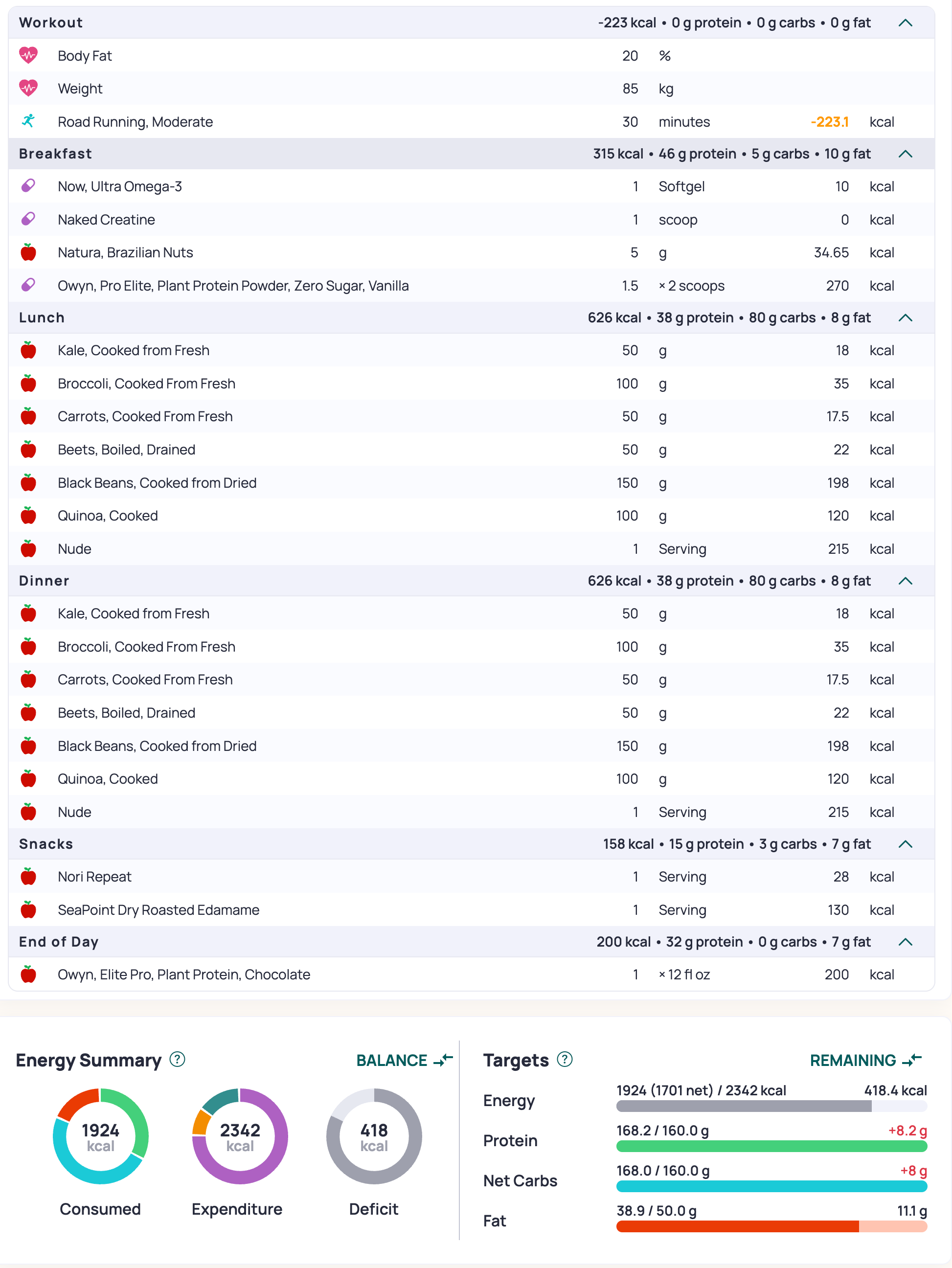
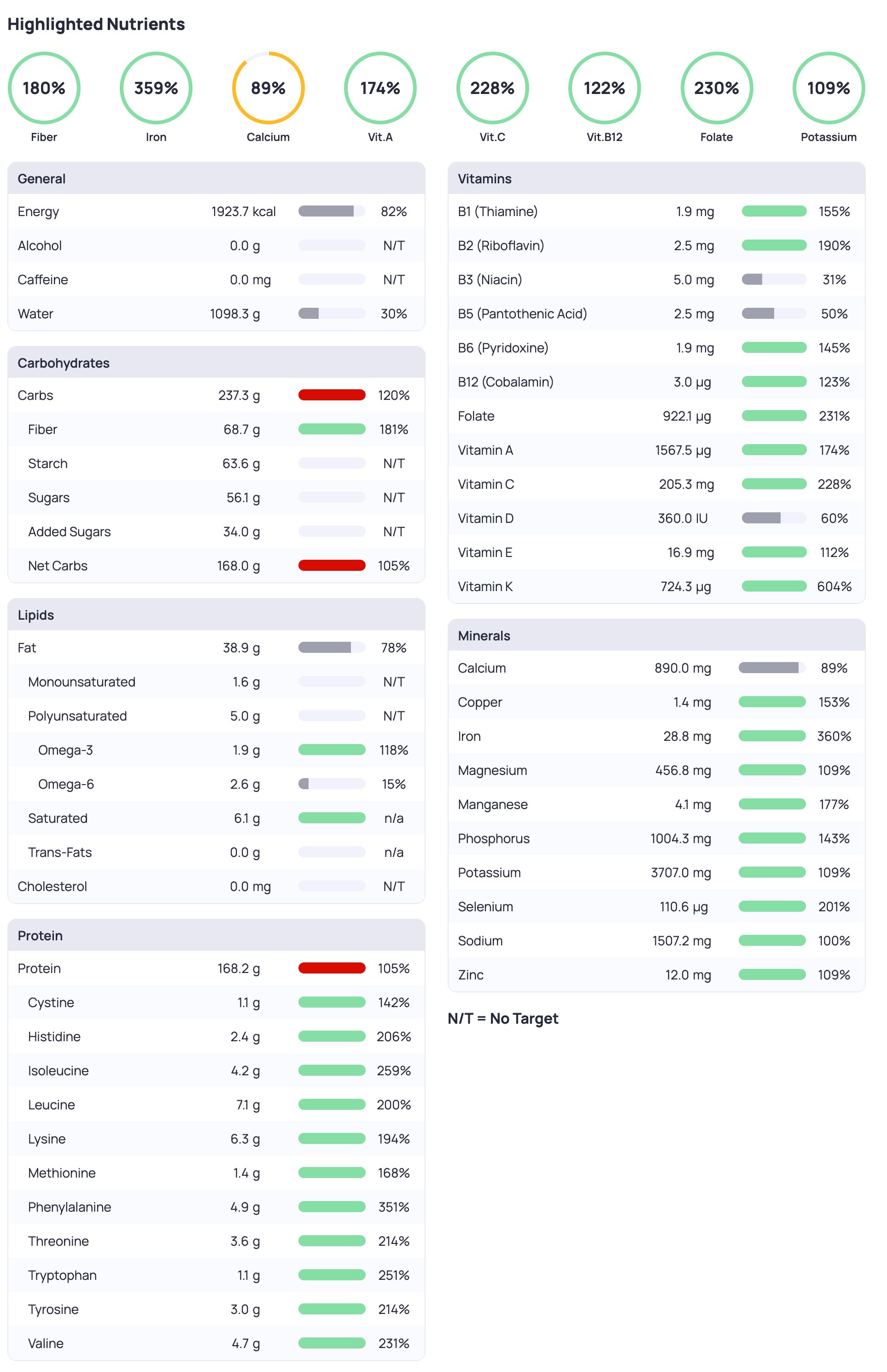
"Mostly vegan": My day-to-day is vegan, but I'll break from it when no healthy alternatives exist—just like anyone might make occasional exceptions.
This week, I had tilapia at a restaurant instead of a veggie burger and fries. The veggie burger would've been vegan but less healthy. I think that's the right call for now.
In summary
- Dieting is hard because we don't know what works, and even if we did, execution is brutal.
- Measure leading indicators—calories and macros—not lagging ones like weight.
- Create a daily diet template and stick to it. Eating the same thing daily is easier than tracking every meal.
- Keep exceptions rare—one or two meals per week, staying at or near your caloric target.
- Exercise helps—it makes maintaining a deficit easier and is healthier overall.
- Expect it to take time—about 1 month per kg of weight loss, plus maintenance periods.
Weight loss isn't random. It just feels that way when you're watching the wrong indicators.