Delegating Attention
Things are different now. We have Neal Stephenson’s editors — we just have to put them to use. Editors read things for you, remove the slop, and surface exactly what you’re looking for.


In 2019, Neal Stephenson wrote Fall — Dodge in Hell. At one point in the novel, he talks about “editors” — the AI and people that curated the information you consumed and shared.
This all had to do with editors. If you were the kind of person who was enrolled at Princeton, you tended to speak of them as if they were individual human beings. [..] Princeton would have supplied him with a fairly decent editor as part of the same package that gave him room, board, and a library card. [..]
Direct, unfiltered exposure to said flumes—the torrent of porn, propaganda, and death threats, 99.9 percent of which were algorithmically generated and never actually seen by human eyes—was relegated to a combination of AIs and Third World eyeball farms, which was to say huge warehouses in hot places where people sat on benches or milled around gazing at stuff that the AIs had been unable to classify.[..]
Stephenson, Neal. Fall; or, Dodge in Hell: A Novel (p. 200). (Function). Kindle Edition.
Stephenson’s dystopia was surpassed by reality in only 7 years: anyone can have an AI editor now — and it’s virtually free.
We just aren’t using them ... yet.
Being on TV vs watching TV
I’ve said this before but it’s worth reemphasizing: being on TV is different from watching TV, but on the internet you’d call both “being on social media.”
We call some people “creators” or “influencers,” but they’re still “on social media” same as the doomscrolling kids and adults.
But content creators and doomscrollers (err, consumers) are nothing alike. Creators are looking for reach, revenue, and an audience that listens to them. Consumers are looking for entertainment, relaxation, and information.
That’s not to say either group gets what they’re looking for. Consumers end up anxious, misinformed, and stressed. And there are countless content creators who make no money, have no reach, and sink hours into content that nobody sees.
That, I think, is the challenge of social media: once you know what you want from it, how do you actually get it, when the platform fails so many people on both sides?
Before 2026, my answer was “just stay out of social media.”
In 2026, I have a new answer:
“Use AI.”
Delegating attention
We hear a lot about the value of attention — how expensive it is to capture, and the billions made by Google, Meta, and others monetizing it.
Before 2026, you had to trade attention for outcomes: you wanted entertainment, information, or relaxation, and the algorithm wanted your attention. That was the deal.
Things are different now. We have Neal Stephenson’s editors — we just have to put them to use. Editors read things for you, remove the slop, and surface exactly what you’re looking for.
Delegating attention gives you control over the “algorithm.” Platforms choose content based on their goals. Your editor filters content based on yours.
Platforms run cheap ML models that find correlations across billions of users to maximize engagement and ad spend. Your own LLM is tuned to process exactly what you want, how you want, for a single person, for pennies.
But what does having an LLM tied to your social media look like?
Here’s what I’m doing.
How my editor works
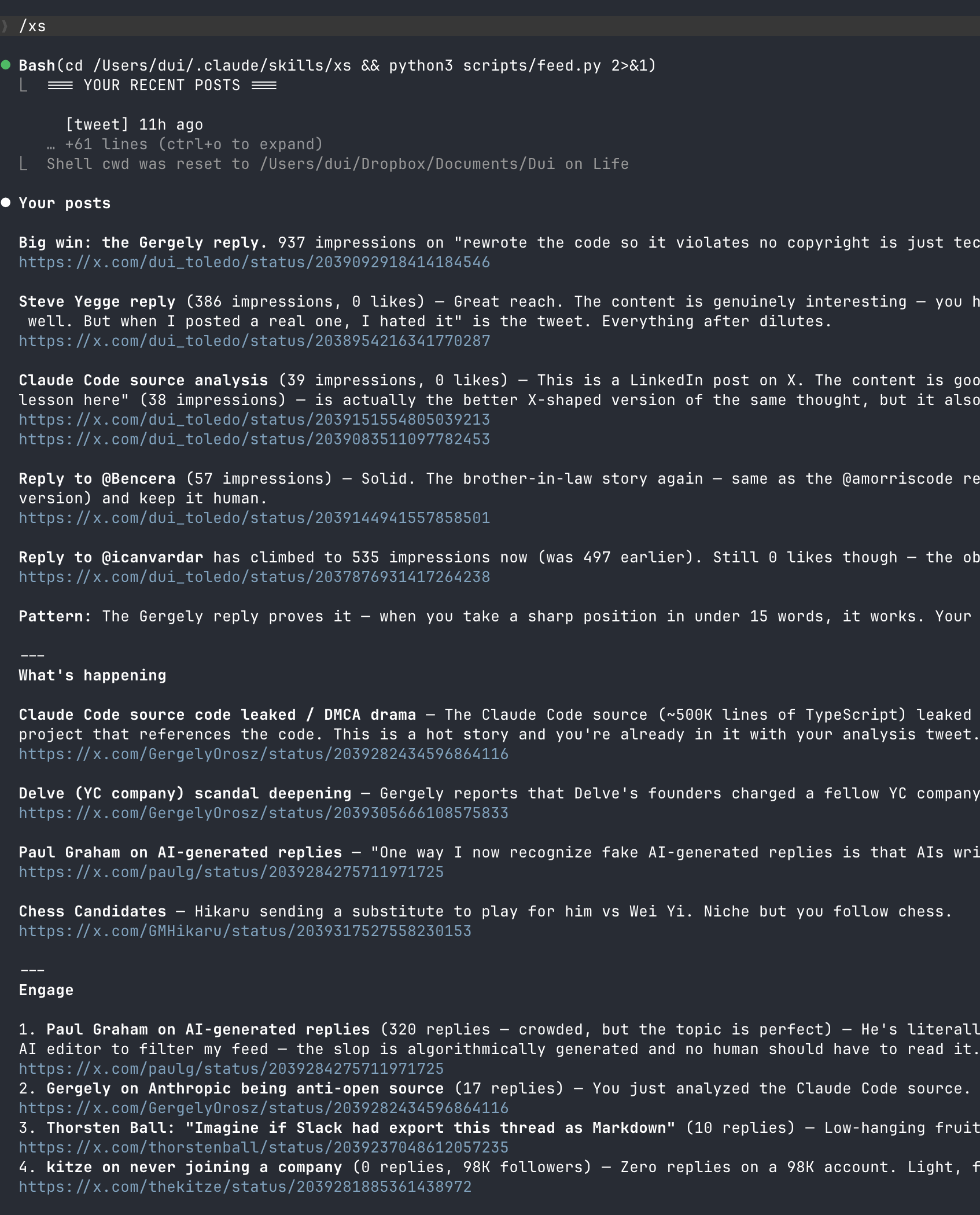
Just like Stephenson’s, my editor helps me with consumption and production.
On the consumer side, it consolidates trends from people I follow and surfaces specific posts I should be aware of, including highlighting posts from my friends (none in this screenshot, though).
On the producer side, it gives me feedback on my recent posts and suggests posts worth replying to — helping me engage in conversation and expand my reach.
I use the X API for this access. It was very easy to build, and costs me pennies to run. I have a similar LinkedIn setup.
With the support of my editor, I have two big advantages over native use: algorithm control and distraction control.
Let’s talk about the algorithm first.
My house, my rules
Like many other social media platforms, X has an “algorithm” — the fancy name we give for their deciding what you get to see, and what you don’t.
The algorithm is influenced by the people you follow, but not just that: the content you’re likely to engage with, content people “like you” engage with, and whatever keeps you on the site longer.
The platform’s incentives are clear: they want you to stay, engage, and make them money.
By running the posts from people I follow through my AI, I get control in two ways:
- I choose exactly whose posts I see by following them.
- My AI summarizes those posts based on my goals, nobody else’s.
The algorithm is just a cheap ML model finding correlations between posts for all social media users. My AI is a sophisticated LLM that processes the content of the posts and shows me exactly what I asked it to.
I’ve only just started, with a small list of people to follow that I had the AI generate for me. I can easily tune it by adding and removing people as I go.
With this algorithmic control, the only other downside I’d have with social media is the added distraction.
And my solution for that is simple.
No social media on the phone
I experimented for a bit with having the apps on my phone, but they’re too distracting.
As someone who didn't own a phone for many years, I want to keep it as a production device, not a consumption device.
There may be another solution for that, but I don’t know what it is yet. Even access to my editor and tools from the phone seems too distracting, let alone access to the apps.
Because my editor can pull everything I need, and I’m only focused on production when on my computer, I limit my social media use to computer only.
For the use of social media on my computer, I’m gravitating towards 2 usages a day: one in the morning, one in the evening.
Using it more than twice a day doesn’t make much of a difference — the info is so edited and consolidated that it’s roughly the same hours later. That also breaks the dopamine loop of “what’s new now?” that the apps are designed around.
Putting the social back in the media
This is all very new. I’ve been at it for a few weeks, and I’m still figuring out the right balance.
I think most importantly, I’ve found a way that works for me to connect to people I want to be connected to, without feeling like I’m the product in an ad platform.
I’m staying on top of AI in a way I couldn’t hope to otherwise. I’m building credibility by helping others and becoming part of communities I’d never have found on my own. And I’m moving out of my comfort zone — all without sacrificing much of my attention and productivity.
This is all possible because I can buy attention and deploy it through AI now, something impossible (or incredibly inaccessible) even just a few months ago.
I think this is a sign of things to come. I hope you’re ready for a future where we’re all delegating attention.. and whatever incentives that creates.
Follow me on https://x.com/dui_toledo and linkedin.com/in/dui-toledo/